
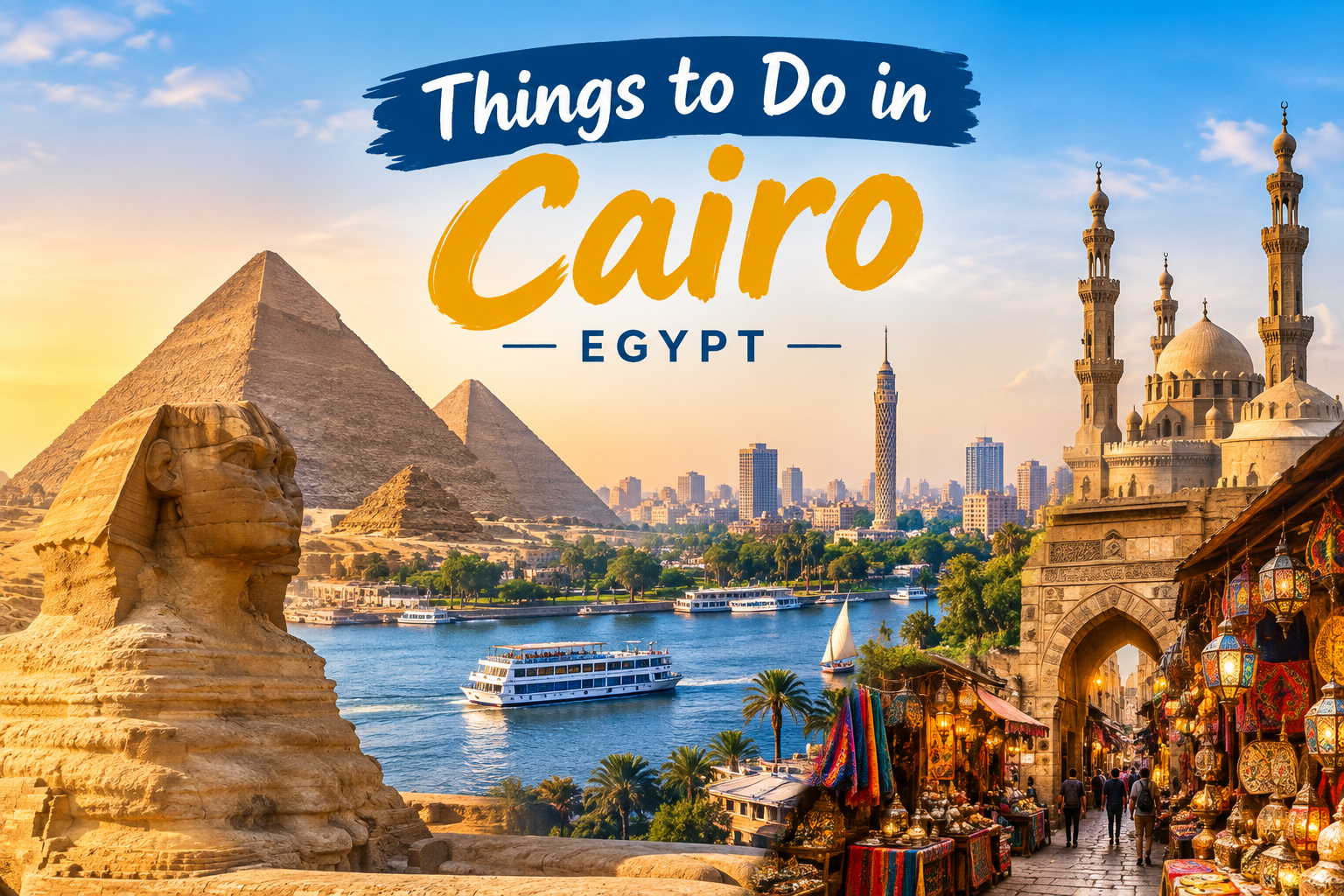
From 4,500-year-old pyramids to buzzing bazaars, discover the best things to do in Cairo — with insider tips, a sample itinerary, and answers to every question first-time visitors ask.
Why Cairo Deserves More Than a Day Trip
Cairo is not just a stopover before the Nile cruise — it is one of the oldest, largest, and most layered cities on Earth, home to more than 20 million people and roughly five thousand years of continuous history stacked on top of itself. Within a single afternoon you can stand beside the last surviving wonder of the ancient world, haggle for spices in a thousand-year-old market, and watch the sun set behind minarets that have called worshippers to prayer since the Middle Ages. Few cities on the planet compress so much civilization into so small a footprint, and even fewer let you experience Pharaonic, Roman, Coptic, Islamic, and modern history all within a 20-kilometer radius.
Many travelers make the mistake of treating Cairo as a one-day formality before heading to Luxor or Aswan. In reality, the Egyptian capital rewards a proper visit of its own — the difference between a rushed half-day at the pyramids and a well-planned two-to-four-day stay is the difference between checking a box and actually understanding why Egypt captivates visitors the way it does.
Whether you are planning a short 3-day Egypt itinerary, a longer 7-day trip, or building Cairo into a broader Nile cruise itinerary, this guide walks you through everything worth doing in the Egyptian capital — organized by neighborhood, interest, and time available — so you can build a day plan that actually works, with realistic timing, ticket advice, and the practical details that generic travel blogs tend to skip.
1. Stand Before the Giza Pyramids and the Great Sphinx
No list of things to do in Cairo can start anywhere else. The Giza Pyramids — Khufu, Khafre, and Menkaure — have stood on the desert plateau for roughly 4,500 years, and they remain the only one of the Seven Wonders of the Ancient World still standing. The Great Pyramid of Khufu alone was the tallest man-made structure on Earth for nearly 3,800 years, a record unbroken until the construction of Lincoln Cathedral in the 14th century. Arrive early, ideally at opening time around 8:00 AM, to beat both the midday heat and the tour-bus crowds, and to catch the soft morning light that photographers favor.
Just below the pyramids sits the Great Sphinx, its lion’s body and human face still guarding the plateau after millennia of desert wind and, at various points in history, being buried up to its neck in sand. Most guided visits combine the pyramids and Sphinx with a stop at the nearby panoramic viewpoint, a slightly elevated vantage point on the plateau’s southern edge where all three pyramids line up in a single frame — the classic postcard shot of Egypt and one of the most photographed views in the world.
For travelers who want the full ancient-Egypt experience in one day, it is worth pairing Giza with Saqqara Necropolis, home to the Step Pyramid of Djoser — the world’s oldest large stone structure and the direct architectural ancestor of the smooth-sided pyramids at Giza — and the City of Memphis, once the capital of ancient Egypt and now an open-air museum with a colossal fallen statue of Ramses II and a striking alabaster sphinx.
Combining all three sites — Giza, Saqqara, and Memphis — in a single day is a popular and efficient option, since they sit within roughly 30 to 45 minutes of each other by car, and together they trace the full evolutionary arc of pyramid-building, from Djoser’s stepped experiment to Khufu’s perfected smooth-sided masterpiece.
Practical tips for visiting Giza
- Go at opening (usually 8:00 AM) or in the last two hours before closing for cooler weather, softer light, and noticeably fewer tour buses.
- A camel or horse ride around the plateau is optional and heavily negotiated — agree on a total price in writing (or a photo of the agreed number) before mounting, since verbal quotes are sometimes “renegotiated” mid-ride.
- Entry to the pyramid interiors is a separate, limited-capacity ticket, and the narrow, low-ceilinged passageways aren’t ideal for anyone with claustrophobia or mobility issues — decide in advance if you want to go inside.
- Bring cash in small denominations (Egyptian pounds) for tips, bottled water, and souvenir vendors, since card payment is rarely accepted at the plateau itself.
- Wear closed, comfortable shoes — the ground is uneven desert rock and sand, not paved walkway.
- Sunscreen, a hat, and sunglasses are essential even in cooler months; there is almost no shade on the plateau.
Where to get the best pyramid photos
Beyond the standard panoramic viewpoint, two other spots are popular with photographers: the rooftop terraces of a handful of cafés along the plateau’s edge, which offer a paid but unobstructed view over a coffee, and the desert road leading toward the panoramic point at sunrise, when the pyramids are silhouetted against a pink sky before the crowds arrive. A growing number of visitors also book a short hot-air balloon-style aerial photo session or a professional local photographer who specializes in pyramid shoots, particularly for engagement or honeymoon photos.
2. Explore the Treasures of the Egyptian Museum and the Grand Egyptian Museum
Downtown Tahrir Square is home to the Egyptian Museum of Antiquities, a pink neoclassical building dating to 1902 that holds one of the world’s largest collections of pharaonic artifacts, including much of Tutankhamun’s treasure — the golden mask, jewelry, and funerary furniture that made headlines in the 1920s and still draw visitors today. The museum’s slightly worn, old-fashioned display style is itself part of the charm: rows of sarcophagi, statues, and papyri crammed floor to ceiling in a way that feels more like an archive than a curated modern exhibit.
Just outside Cairo, the long-awaited Grand Egyptian Museum (GEM) has opened near the Giza Plateau as the largest archaeological museum in the world dedicated to a single civilization. Two decades in the making, it houses over 100,000 artifacts, including the complete Tutankhamun collection displayed together for the first time in one gallery, a soaring atrium dominated by a colossal statue of Ramses II, and a monumental grand staircase lined with statues that leads visitors chronologically through Egyptian history from the Old Kingdom to the Greco-Roman period. For anyone serious about ancient Egypt, the GEM’s tourist walkway alone is worth half a day, and the museum’s floor-to-ceiling windows facing the Giza Plateau mean you can see the pyramids from inside the galleries.
Deciding between the two museums is a common question for first-time visitors. In short: the Grand Egyptian Museum offers a modern, spacious, chronologically organized experience with the complete Tutankhamun collection, while the older Egyptian Museum in Tahrir Square retains a raw, archive-like charm and some pieces (particularly the Royal Mummy Room artifacts and select New Kingdom items) not yet transferred to GEM. Travelers with limited time should prioritize GEM; those with two or more days in Cairo can comfortably do both.
History enthusiasts can round out the museum circuit with the National Museum of Egyptian Civilization in Old Cairo, notable for its Hall of Royal Mummies, where the preserved bodies of pharaohs including Ramses II and Hatshepsut are displayed in climate-controlled, respectfully lit cases, along with a broader narrative exhibit tracing Egyptian civilization from prehistory through the modern era.
3. Wander Islamic Cairo’s Mosques, Citadel, and Medieval Streets
UNESCO-listed Islamic Cairo is one of the largest and best-preserved historic Islamic city centers in the world, packed with medieval mosques, madrasas, caravanserais, and covered markets along winding stone streets that have barely changed their footprint in seven hundred years. It rewards slow walking more than any other district in the city, and it’s the one part of Cairo where getting a little lost is genuinely part of the experience.
The centerpiece is the Saladin Citadel, a hilltop fortress built in the 12th century by the legendary Muslim leader Saladin to defend Cairo against Crusader attacks, and which served as the seat of Egyptian government for nearly 700 years afterward. Inside its walls stands the Mohamed Ali Mosque — often called the Alabaster Mosque for the creamy stone that clads its lower walls and courtyard — whose Ottoman-style domes and twin minarets dominate the Cairo skyline and offer one of the best panoramic views in the city, stretching from the Nile all the way to the Giza Plateau on a clear day.
Nearby, two more architectural landmarks deserve a stop: the Sultan Hassan Mosque, a masterpiece of Mamluk architecture built in the 14th century and famous for its monumental entrance, soaring interior courtyard, and four vaulted halls representing the four schools of Sunni Islamic law, and the Ibn Tulun Mosque, one of the oldest mosques in Egypt still in its original form (completed in 879 AD), with a distinctive spiral minaret — inspired by ancient Mesopotamian ziggurats — that visitors can climb for sweeping rooftop views over the rooftops of Islamic Cairo.
For a deeper dive into the medieval streetscape, walk Al-Muizz Street, an open-air museum of Fatimid, Mamluk, and Ottoman architecture lined with restored gates, fountains, merchant houses, and historic sabils (public water fountains) — especially atmospheric in the early evening when the street lights come on and local families come out for tea and dessert at the historic El Fishawy café, one of the oldest continuously operating coffeehouses in the world.
Because Islamic Cairo covers a wide area and the sites are best appreciated slowly, many visitors find it worthwhile to hire a knowledgeable local guide for this district specifically — the architectural details, religious symbolism, and layered history of overlapping dynasties are easy to miss without context, and a guide can also help navigate which mosques require modest dress or head coverings for women.
4. Get Lost (Happily) in Khan El Khalili Bazaar
No visit to Cairo is complete without Khan El Khalili, a labyrinthine bazaar dating back to the 14th century, when it began as a caravanserai for trading caravans arriving from across the Islamic world. Today, narrow alleys overflow with spice stalls, gold and silver jewelry, hand-blown glass lamps, hand-painted papyrus, leather goods, inlaid wooden boxes, and perfume shops selling essential oils by weight — plus the aroma of fresh-roasted coffee and grilled corn drifting from centuries-old cafés tucked between the stalls.
Haggling is expected and part of the fun; start at roughly a third to half of the initial asking price and negotiate from there, staying friendly and unhurried — vendors respond far better to good-natured bargaining than to aggressive lowballing. Buying two or three items from the same stall often earns a better combined price than negotiating each item separately.
For a completely different atmosphere, come back after dark — Khan El Khalili at night takes on a magical glow as strings of lanterns light the alleyways, shisha smoke drifts from café terraces, and the daytime tour-group crowds thin into a more local, relaxed scene of Cairenes out for tea and conversation.
The bazaar sits within the broader souks of Cairo, a wider network of specialized markets — spice souks, gold souks, and textile markets among them — each worth a browse if you have extra time and want to see where locals, not just tourists, actually shop. It’s also the best place in the city to shop for authentic Egyptian souvenirs, from alabaster figurines and hand-blown perfume bottles to cartouche jewelry engraved with your name in hieroglyphs — a favorite souvenir among first-time visitors.
5. Step Into Coptic and Old Cairo
Coptic Cairo is a walled quarter within Old Cairo that traces the roots of Egyptian Christianity back nearly two thousand years, to some of the earliest Christian communities anywhere in the world. Its quiet cobblestone lanes hold some of the oldest churches on Earth, built above and around the remains of a Roman fortress known as Babylon-in-Egypt, whose round towers are still visible flanking the entrance to the quarter.
The must-see stop is the Hanging Church (El Muallaqa), so named because it was constructed atop the gatehouse towers of that Roman fortress, giving it a distinctive suspended appearance above street level. Its wooden ceiling, carved in the shape of Noah’s Ark, and its collection of icons and inlaid ebony-and-ivory screens dating back centuries make it one of Cairo’s most atmospheric religious sites, and it remains an active place of worship for Egypt’s Coptic Christian community, one of the oldest continuous Christian populations in the world.
Nearby, the neighborhood’s ancient Ben Ezra Synagogue — believed to occupy the site where the infant Moses was found in the reeds, according to local tradition — sits within a few minutes’ walk of the Amr ibn al-As Mosque, the first mosque ever built in Egypt or Africa. Having a nearly 2,000-year-old synagogue, a medieval church, and Africa’s first mosque within a five-minute walk of each other is a rare, tangible reminder of Cairo’s long history of religious layering and coexistence, and it’s one of the most quietly moving corners of the entire city.
6. Cruise or Dine on the Nile
The Nile isn’t just scenery in Cairo — it’s the city’s main thread, the reason the metropolis exists where it does, and it still shapes daily life the way it has for millennia. A short felucca sail at sunset near Zamalek or Manial Island is one of the most relaxing things to do in Cairo, especially after a full day of temples and markets — these traditional wooden sailboats have no motor, so the only sounds are the wind in the canvas and the city noise fading into the background.
For something more structured, dinner cruise boats depart from docks along the Corniche and combine a multi-course meal with Tanoura folk dancing and live music while the illuminated Cairo skyline glides past — a popular choice for couples and larger groups who want an evening activity that doesn’t involve more walking after a long day of sightseeing.
If your trip continues south, it’s worth reading up on how a multi-day Nile cruise itinerary works between Luxor and Aswan, or comparing a Nile cruise versus a land tour to decide which style of travel suits your pace and budget better. Solo travelers in particular should check dedicated advice on taking a Nile cruise solo, since cabin pricing and social dynamics on board work differently than for couples or families.
7. Experience Cairo After Dark
Cairo does not slow down when the sun sets — arguably, it gets more interesting, since the daytime desert heat fades and the city’s rhythm shifts toward its most social hours. Cairo at night reveals a different city: illuminated minarets across the skyline, the Cairo Tower lit up over the Nile on Zamalek island, riverside cafés filling with families and shisha smokers well past midnight, and street food stalls serving koshari, ful medames, and grilled corn until the early hours.
For a broader look at where to go, Cairo Egypt at night guides usually point visitors toward the Nile Corniche for a riverside stroll, the rooftop bars and lounges of Zamalek and Garden City for skyline views, and the Khan El Khalili night scene for a more traditional, market-town atmosphere. The Cairo Tower itself, a 187-meter lattice structure completed in 1961, offers a revolving observation deck with 360-degree views that are especially striking after dark.
If you want a broader survey of the country’s after-dark scene beyond the capital, Egypt nightlife stretches from Cairo’s rooftop lounges to Red Sea beach clubs in Hurghada and Sharm El Sheikh, though Cairo itself remains the country’s most diverse nightlife scene by far, ranging from quiet ahwa (traditional coffeehouse) culture to modern nightclubs.
8. Things to Do in Cairo With Family and Kids
Cairo is more family-friendly than many first-time visitors expect. The Giza Plateau, the Egyptian Museum’s mummy rooms, and horse-drawn carriage rides genuinely captivate children, while air-conditioned museum breaks help manage the midday heat and give younger travelers a rest from walking. Camel and horse rides at Giza are also reliable crowd-pleasers for kids old enough to sit securely, and most sites have decent restroom facilities near the entrances.
Beyond the headline sites, Cairo has a small but growing number of dedicated family attractions, including aquariums, amusement parks on Nile islands, and puppet theaters in some of the city’s cultural centers, which can help break up a trip that would otherwise be entirely temples and museums. For a full breakdown of age-appropriate activities, transportation tips, and where to eat with picky eaters, see this guide to things to do in Cairo with family, and the wider guide on taking kids to Egypt, which covers the rest of the country, including which Nile cruise cabins and Red Sea resorts work best for younger travelers.
9. Sample Cairo Itineraries: 1, 2, or 3 Days
How you structure your time in Cairo depends heavily on how many days you have. Below are three realistic frameworks, from a rushed single day to a relaxed long weekend, each built around the sites covered above.
24 Hours in Cairo
If you only have one day — a common scenario for cruise passengers docking at Sokhna or Alexandria, or travelers with a long layover — prioritize Giza in the morning while the light and temperature are best, grab lunch at a restaurant near the pyramids with a plateau view, then head to the Egyptian Museum or GEM in the early afternoon. Finish with a sunset felucca ride on the Nile or an early dinner in Islamic Cairo near the Citadel. This pace is tight but genuinely doable with a private driver or organized tour, since it removes the guesswork of navigating traffic and ticket lines independently. A detailed hour-by-hour plan is available in this 24 hours in Cairo itinerary.
2 Days in Cairo
With two full days, the pace relaxes considerably. Day one covers Giza in the morning, followed by Saqqara and Memphis in the early afternoon, leaving the evening free for a Nile dinner cruise or a walk along the Corniche. Day two is dedicated to Islamic Cairo — the Saladin Citadel and Mohamed Ali Mosque first thing in the morning, followed by Sultan Hassan and Ibn Tulun mosques, then Al-Muizz Street and Khan El Khalili Bazaar in the afternoon and evening, when the market comes alive with locals as well as tourists. This structure groups sites by geography, which cuts down significantly on cross-city driving time.
3+ Days in Cairo
With three or more days, add the Grand Egyptian Museum as its own half-day (it genuinely deserves one, given its size), a Coptic Cairo and Old Cairo morning paired with the National Museum of Egyptian Civilization, and consider a day trip option such as Alexandria on the Mediterranean coast or the Fayoum Oasis for desert scenery and Lake Qarun. A longer stay also leaves room to slow down in Khan El Khalili for proper souvenir shopping, catch a Tanoura dance performance, or simply spend an unhurried evening in a Zamalek café.
For a full breakdown by trip length, browse the complete set of Cairo travel itineraries, or scale up to a full national trip that pairs Cairo with Luxor, Aswan, and the Red Sea, using the 4-day, 5-day, 7-day, 10-day, or 14-day Egypt itinerary guides.
10. Practical Information for Visiting Cairo
Getting to and around Cairo
Most international visitors arrive through Cairo International Airport, one of the busiest hubs in the Middle East and North Africa, and it helps to review the arrivals process in advance, including visa-on-arrival counters, currency exchange desks, and official taxi stands, so you’re not making decisions on the spot after a long flight.
Within the city, ride-hailing apps (Uber and Careem both operate widely and are generally the most convenient and transparent way to pay) are the easiest way to get around for most visitors, since fares are fixed in advance and drivers don’t require cash haggling. Traditional taxis are cheaper but require negotiating a fare before the ride starts. Cairo traffic is notoriously heavy, especially during weekday rush hours (roughly 8–10 AM and 4–7 PM), so it’s wise to build 30 to 60 extra minutes into any cross-city journey, and to avoid scheduling back-to-back activities in different neighborhoods too tightly.
For visitors staying several days and covering multiple sites daily, a private driver or guided day tour often works out more efficient than public transport or repeated ride-hailing, since it eliminates wait times and lets the driver navigate parking at busy sites like Giza and the Citadel.
Visas and entry requirements
Most nationalities can obtain an Egypt entry visa on arrival at the airport for a fee payable in cash or card, or apply in advance through official channels. Increasingly, many travelers now qualify to apply for an Egypt e-visa online before departure, which saves time standing in arrival-hall queues and lets you head straight to immigration and baggage claim.
When to visit
Cairo is a year-round destination, but the cooler months from October through April are the most comfortable for walking tours and outdoor sightseeing at sites like Giza and the Citadel, where there’s little shade. Summer (June through August) brings intense heat, often well above 35°C (95°F), so outdoor sightseeing is best scheduled for early morning or late afternoon during those months. If you’re weighing your options, compare conditions across the best time to travel to Egypt guide, or check seasonal specifics like January weather, July weather, summer conditions, or what to expect during Ramadan in Egypt, when opening hours, daytime dining, and the general pace of the city shift noticeably.
Money, tipping, and food
Cash is still king in markets, for tipping, and at smaller restaurants, so it’s worth carrying Egyptian pounds in small denominations at all times — read up on tipping etiquette in Egypt before your trip so you know what’s expected for guides, drivers, hotel staff, and restaurant servers, since tipping (baksheesh) is woven more deeply into daily service culture in Egypt than in many other countries. And don’t leave Cairo without trying the local specialties covered in this guide to popular Egyptian foods, from koshari — the unofficial national dish of rice, lentils, pasta, and crispy onions — to molokhia, ful medames, and freshly grilled kofta.
Safety and common scams
Cairo is generally safe for tourists who take normal city precautions, and violent crime against visitors is rare. It’s still worth reading a quick overview of safety in Egypt and common tourist scams in Egypt — mainly overpriced “tips” for unsolicited help, unofficial guides approaching visitors at monuments, and inflated camel or horse-ride fees quoted after the ride has already started — so you can enjoy the sights without the hassle. Solo and female travelers may also want to review dedicated guidance on solo female travel safety in Egypt.
What to pack
Modest, breathable clothing works best for mosque visits and desert sun alike — loose cotton or linen layers, a scarf or shawl for women entering mosques and churches, and sturdy closed shoes for walking on uneven stone and desert ground. See the full Egypt packing list for specifics on footwear, sun protection, adapters, and mosque-appropriate coverings.
11. Beyond the Highlights: Lesser-Known Things to Do in Cairo
Once you’ve covered the essentials, Cairo has plenty of quieter, less-visited corners worth the extra effort. The neighborhood of Zamalek, an island in the Nile, offers a leafy, walkable break from the busier parts of the city, with independent art galleries, boutique shops, and riverside cafés that feel a world away from Giza’s crowds. Garden City, just south of downtown, is known for its early-20th-century architecture and winding, Paris-inspired streets laid out during the colonial era.
For panoramic views without the Cairo Tower’s admission line, several rooftop restaurants and hotel terraces around Tahrir Square and along the Corniche offer similarly sweeping vistas over a meal or coffee. History buffs with extra time might also enjoy Al-Azhar Park, a large, immaculately landscaped green space built over a former rubble dump, which offers unexpected views back toward the Citadel and Islamic Cairo’s skyline of domes and minarets — a peaceful contrast to the density of the historic core.
Travelers looking to extend their trip beyond the capital often add a day trip to Alexandria on the Mediterranean coast, roughly a three-hour drive away, or explore the desert landscapes of the Western Desert and its oases for a completely different side of Egypt.
Frequently Asked Questions About Things to Do in Cairo
How many days do I need in Cairo?
Two to four days is enough to cover the essentials — Giza, the Egyptian Museum or GEM, Islamic Cairo, and Khan El Khalili — without feeling rushed. A single day is workable if you focus only on Giza and the museum.
What is the number one thing to do in Cairo?
Visiting the Giza Pyramids and Sphinx is consistently ranked the top activity, both for its historical significance and because it is the only surviving Wonder of the Ancient World.
Is Cairo walkable for tourists?
Parts of Cairo, particularly Islamic Cairo and Zamalek, are enjoyable to explore on foot. However, distances between major sites like Giza, downtown, and Coptic Cairo are large and traffic is heavy, so taxis or a private driver are recommended for moving between districts.
Can I visit Cairo without a guide?
Yes, independent travel is possible, especially with ride-hailing apps for transport. That said, a licensed Egyptologist guide adds significant historical context at sites like the pyramids and the museum, and can help navigate ticket lines and site regulations more efficiently.
What should I avoid doing in Cairo?
Avoid agreeing to any service, photo, or “gift” from unofficial vendors before confirming the price, and be cautious of unsolicited offers of help at tourist sites that end with a request for payment. It’s also worth avoiding overly ambitious single-day plans that try to combine Giza, downtown, Islamic Cairo, and Coptic Cairo all at once — Cairo’s traffic makes that kind of itinerary exhausting rather than enjoyable.
Should I visit the Egyptian Museum or the Grand Egyptian Museum?
If you only have time for one, the Grand Egyptian Museum offers the more complete and modern experience, including the full Tutankhamun collection. Travelers with an extra half-day should visit both, since the older museum still holds pieces not yet transferred to GEM.
Is Cairo worth visiting if I’m short on time in Egypt?
Yes — even a single well-planned day in Cairo, focused on Giza and one museum, delivers some of the most significant historical sites in the world. If your schedule allows, extending to two or three days lets you add Islamic Cairo and Khan El Khalili, which round out the experience considerably.
Ready to Explore Cairo?
Browse our Cairo day tours or start planning with a full Cairo tour package — private guides, skip-the-line tickets, and comfortable transport included.