
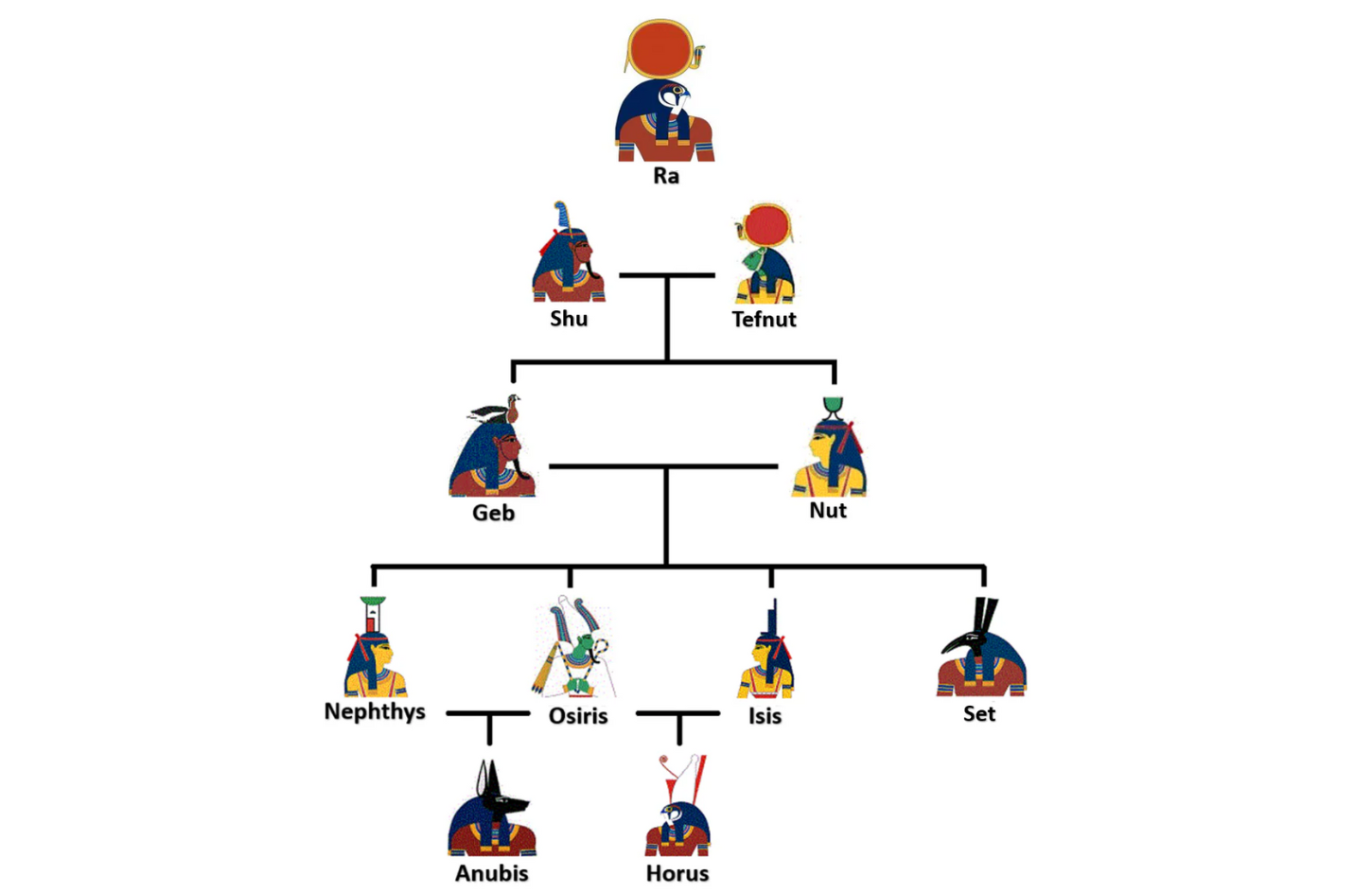
Ancient Egyptian mythology is one of the most complex and fascinating belief systems in human history. At the heart of this mythology lies the family tree of the Egyptian gods. This divine genealogy explains how the universe was created, how order was maintained, and how kingship was passed from one generation to another. Understanding the Egyptian gods’ family tree offers deep insight into how ancient Egyptians viewed life, death, and the cosmos itself.
Rather than a single, fixed structure, the ancient Egyptian gods’ and goddesses’ family tree evolved, shaped by regional beliefs, political power, and religious traditions. Yet, certain divine families remained central to Egyptian theology for thousands of years.
The Origins of the Family Tree of the Egyptian Gods
According to ancient Egyptian belief, creation began with chaos, known as Nun, the endless primeval waters. From this chaos emerged the first ancient Egyptian god, usually identified as Atum or Ra, depending on the tradition.
Atum created the first divine pair—Shu, the god of air, and Tefnut, the goddess of moisture. This moment marked the beginning of the Egyptian gods’ family tree, where creation unfolded through divine relationships rather than a single act.
Shu and Tefnut then gave birth to Geb, the god of the earth, and Nut, the goddess of the sky. Their union formed the foundation upon which all later gods and goddesses would descend.
Read More About Ancient Egyptian Festivals & Celebrations
Geb and Nut: The Core of the Divine Lineage
The relationship between Geb and Nut is one of the most important in the ancient Egyptian gods and goddesses family tree. From them came four of the most influential deities in Egyptian mythology:
- Osiris
- Isis
- Set
- Nephthys
These siblings shaped nearly every major myth and religious belief in ancient Egypt. Their stories explain concepts of kingship, death, rebirth, chaos, and balance—principles essential to Egyptian civilization.
Nut, as an Egyptian goddess, was believed to swallow the sun each evening and give birth to it every morning, reinforcing the idea of eternal renewal that runs throughout Egyptian theology.
Osiris: The Ancient God of Egypt and Divine King
Among all divine figures, Osiris stands out as one of the most important gods in the Egyptian pantheon. As an ancient god of Egypt, Osiris ruled as the divine king who brought civilization, agriculture, and law to humanity.
His murder by his brother Set marked a turning point in the Egyptian gods’ family tree. Osiris’ death did not end his influence; instead, he became the ruler of the underworld, overseeing judgment and the afterlife.
Osiris’ role established a powerful belief: death was not an end, but a transition—an idea that deeply influenced Egyptian burial practices and religious rituals.
Isis: The Egyptian Goddess of Magic and Motherhood
Isis, wife and sister of Osiris, is one of the most revered figures in the Egyptian gods’ family tree. As a powerful Egyptian goddess, she embodied magic, protection, healing, and maternal devotion.
Using her magical abilities, Isis resurrected Osiris long enough to conceive their son Horus. This act secured the continuation of divine kingship and reinforced Isis’s role as the ultimate divine mother.
Isis’ popularity extended far beyond Egypt, and her worship spread throughout the Mediterranean world, making her one of the most influential goddesses in ancient history.
Horus and the Continuation of Divine Rule
Horus, the son of Isis and Osiris, represents the living king on earth. His struggle against Set symbolized the eternal battle between order and chaos—a recurring theme in deity beliefs.
In the family tree of the Egyptian gods, Horus stands as the bridge between gods and humans. Every pharaoh was believed to be the earthly embodiment of Horus, ruling by divine right.
Horus’ victory over Set restored balance to the cosmos and reinforced the idea that rightful kingship was divinely ordained.
Set and Nephthys: Chaos, Protection, and Balance
While often portrayed as a villain, Set played a necessary role within the Ancient Egyptian gods and goddesses’ family tree. As the god of chaos, storms, and the desert, Set represented forces that threatened order but were essential to cosmic balance.
Nephthys, his wife and sister, was a protective Egyptian goddess associated with mourning, burial rites, and the transition between life and death. Despite her association with Set, she aided Isis in protecting Horus and restoring Osiris.
Together, Set and Nephthys demonstrate that Egyptian mythology did not divide gods into purely good or evil, but rather into forces that maintained balance.
Other Divine Families and Regional Triads
Beyond the Osirian family, Egyptian religion featured several divine triads that expanded the Egyptian gods’ family tree:
- The Theban Triad: Amun, Mut, and Khonsu
- The Memphite Triad: Ptah, Sekhmet, and Nefertum
These family units reflected local worship traditions while remaining connected to the larger divine genealogy. Each deity Egypt worshipped played a specific role within both cosmic and human life.
Egyptian Gods Names List and Divine Roles
An Egyptian gods names list reveals the diversity of divine responsibilities in ancient belief:
- Ra—Sun god and creator
- Thoth – God of wisdom and writing
- Anubis – God of mummification
- Hathor – Goddess of love and joy
- Sekhmet – Goddess of war and healing
Each god and Egyptian goddess fits into the broader family tree, either through direct lineage or symbolic association.
Why the Egyptian Gods’ Family Tree Still Matters
The family tree of the Egyptian gods was more than mythology—it was a framework that explained nature, politics, morality, and the afterlife. By tracing divine relationships, ancient Egyptians understood their place in the universe and their connection to the gods.
Today, studying the Egyptian Gods’ Family Tree continues to inspire historians, travelers, and mythology enthusiasts, offering timeless insight into one of the world’s greatest civilizations.
FAQs – The Egyptian Gods’ Family Tree
What is the family tree of the Egyptian gods?
The family tree of the Egyptian gods explains the divine relationships between creator gods, goddesses, and their descendants. It shows how ancient Egyptians understood creation, order, kingship, and the afterlife through divine lineage.
Who was the first ancient god of Egypt?
The first ancient god of Egypt was commonly believed to be Atum or Ra, who emerged from the primeval waters of Nun and began the creation of other gods and goddesses.
Who are the most important gods in the Egyptian gods’ family tree?
The most important figures include Atum or Ra, Shu, Tefnut, Geb, Nut, Osiris, Isis, Set, Nephthys, and Horus. These deities form the core of the Ancient Egyptian gods and goddesses family tree.
What role does the Egyptian goddess Isis play in the family tree?
Isis is a central Egyptian goddess known for magic, protection, and motherhood. She is the wife of Osiris and the mother of Horus, making her vital to the continuation of divine kingship.
How is Horus connected to Egyptian kings?
Horus represents the living king in ancient Egypt. Pharaohs were believed to be earthly manifestations of Horus, linking royal authority directly to the gods’ family tree.
Why is Osiris important in Egyptian mythology?
Osiris is an ancient god of Egypt associated with death, resurrection, and the afterlife. His story explains the cycle of death and rebirth and shaped Egyptian beliefs about eternal life.
Are all Egyptian gods related by blood?
Not all deities are directly related by blood. Some gods were connected symbolically or through regional traditions, forming divine triads and theological groupings across Egypt.
What is the Ennead in Ancient Egyptian religion?
The Ennead is a group of nine gods worshipped mainly in Heliopolis. It represents a structured version of the Egyptian gods’ family tree, starting with Atum and ending with Horus.
Where can I find an Egyptian gods names list?
An Egyptian gods names list can be found in ancient texts, temple inscriptions, and modern mythology studies, often grouped by their roles, powers, and family relationships.
Why is the Egyptian gods’ family tree still studied today?
It helps historians, students, and travelers understand ancient Egyptian beliefs, religious symbolism, and how mythology shaped one of the world’s greatest civilizations.